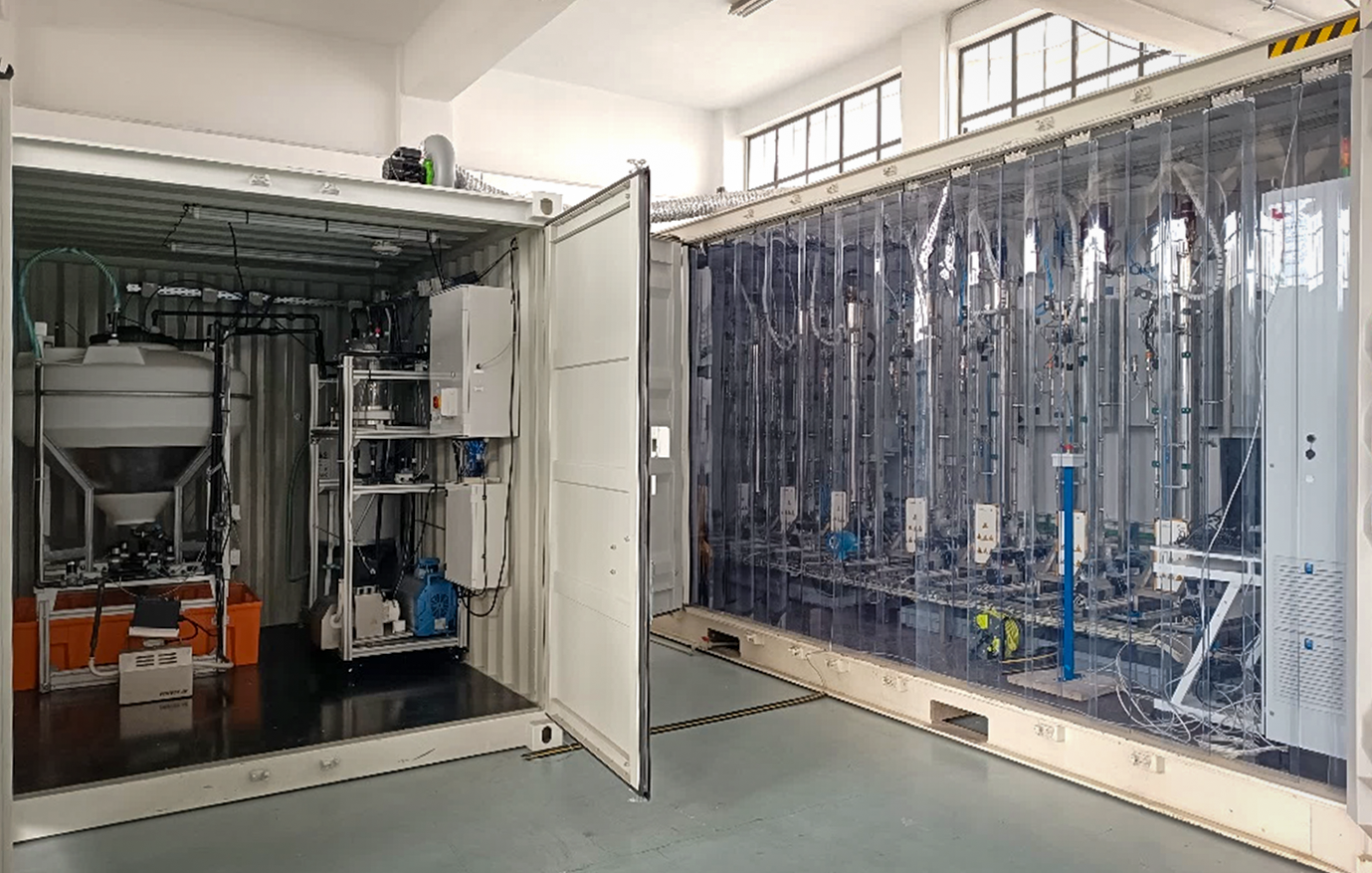
Leaving no scrap behind
PEACOC does not stop at recovering precious metals. The project also aims to show how recycled platinum group metals (PGMs) and other valuable materials (i.e., Ag and Au) can return to industrial use across various sectors, such as automotive manufacturing, energy technologies and advanced materials.
Part of Stellantis N.V. Group, Centro Ricerche Fiat (CRF) coordinates the use of recycled platinum, palladium and related metals to manufacture, operate and test automotive catalysts. In parallel, the project supports the production of catalytic nanoparticles for electrochemical energy technologies, 3D‑printed products and single‑metal streams for new markets. This work supports a near‑zero‑waste approach, where both metals and residual materials find a second-life instead of becoming disposal streams.
Recycled PGMs in automotive catalysts
The project already uses recycled PGMs in the production of automotive catalysts in metal/alloys form or from unpurified leaching solutions with different metal combinations and concentrations. The team at MONOLITHOS (MON) continues to develop the synthesis routes, relying on an innovative protocol previously developed and validated in the PROMETHEUS project, which has proven effective for automotive emission treatment. The resulting catalysts meet specifications and performance comparable to commercial products.
MONOLITHOS has already started adjusting the process to meet the technical requirements defined by CRF and FORD OTOSAN, including precise platinum and palladium loadings.
Catalytic nanoparticles for energy technologies
The project also applies recycled PGMs to produce catalytic nanoparticles for electrochemical energy technologies. The team at Monolithos first assessed suitable synthesis routes using commercial platinum‑on‑carbon precursors. In parallel, VITO team has focussed on developing the GDEx process beyond recovery but also as a synthesis tool to produce relevant Pt and Pd-based catalytic nanoparticles using also commercial precursors. Test results showed electrochemical performance of these materials comparable to that of commercial catalysts.
The project also applies recycled PGMs to produce catalytic nanoparticles for electrochemical energy technologies. The team at Monolithos first assessed suitable synthesis routes using commercial platinum‑on‑carbon precursors. In parallel, VITO team has focussed on developing the GDEx process beyond recovery but also as a synthesis tool to produce relevant Pt and Pd-based catalytic nanoparticles using also commercial precursors. Test results showed electrochemical performance of these materials comparable to that of commercial catalysts.
With benchmarking and validation completed, the next step focuses on using recycled metals. VITO and MONOLITHOS are now preparing to collect material recovered through the GDEx process at VITO to produce electrocatalysts based entirely on recycled inputs.
Single‑metal streams for new markets
Beyond multi‑metal applications, the project also targets the separation of precious metals into single‑metal streams. TECNALIA (TEC) has developed a patented process that separates platinum and palladium from solid samples. The team now applies this process to different automotive catalyst samples while adjusting operational parameters, including the composition of deep eutectic solvents.
The process runs in a two‑chamber setup and is expected to produce two solid outputs. One stream contains more than 75% palladium and over 25% platinum. The second stream contains more than 90% platinum, with small amounts of rhodium. The team plans to patent this separation route as well, opening access to new markets that require higher metal purity.
Giving value to residual materials beyond precious metals
The project also addresses what remains after metal recovery. Work on residual matrices from refining and wastewater treatment focuses on identifying materials that can still serve other industries.
The team at TECNALIA tested magnetic fractions without silver for upcycling and analysed samples processed by TUDelft (TUD). Even after milling and process adjustments, significant amounts of silver remained in some residues, pointing to further recovery opportunities.
In parallel, TECNALIA processed depleted liquid streams from the gas-diffusion electrocrystallisation (GDEx) that contained rare earth elements (REEs) such as cerium and lanthanum. Using a sequence of double‑sulphate precipitation, alkali conversion and calcination, the team recovered rare earth elements, although some salts still remained unexplored. Further work now focuses on improving yields while making the process safer.
TECNALIA also achieved recovery rates above 90% for copper and tin from selected samples. The research team also investigates the recovery of tantalum from electronic components, further broadening the range of materials that can re‑enter industrial value chains.
© photo Monolithos
 This
project has received funding from the European Union’s
Horizon 2020 research and innovation programme under grant
agreement No 958302.
This
project has received funding from the European Union’s
Horizon 2020 research and innovation programme under grant
agreement No 958302.