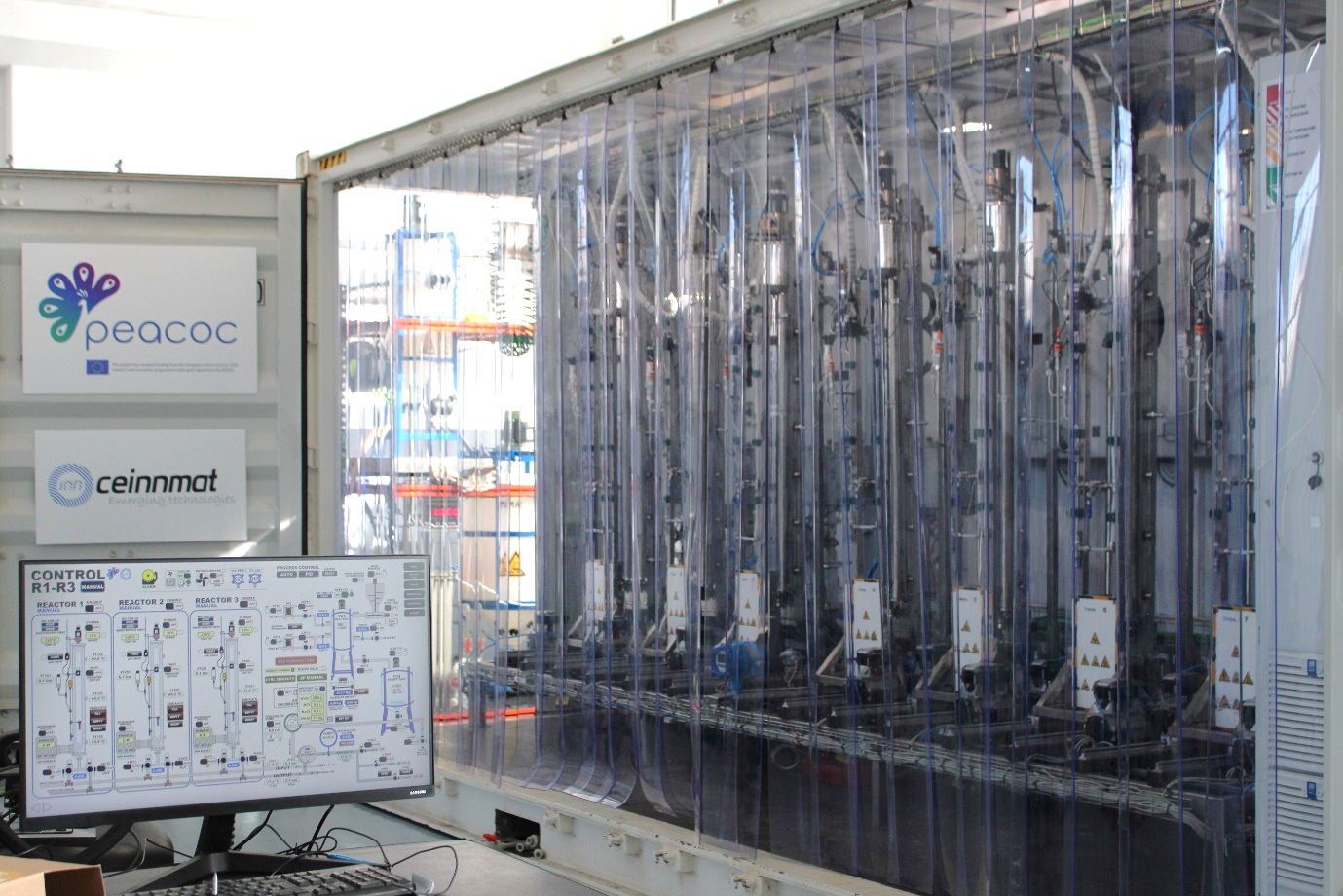
Demonstrator of the pre-commercial pilot of the PEACOC project
After almost two years of work, PEACOC moved entirely from laboratory-scale validation to pre-commercial pilot. The PEACOC pilot is, in fact, a setup of three connected units engineered and tailored to the technologies that will recycle precious metals from European waste. It currently occupies an industrial area of no less than 200 m² on the premises of MONOLITHOS in Athens, where it will operate under real industrial conditions.
VITO, CEINNMAT, 6TMIC, TECNALIA and MONOLITHOS – jointly carried out the preparation, installation and commissioning of the pilot. Each partner validated the modules and subsystems under their responsibility. This coordinated work ensured that all modules were aligned in terms of mechanical and electrical connections, process compatibility, automation and safe operation, allowing the transition from construction to a fully operational system ready for demonstration.
Phased installation at the Athens site
The pilot units were delivered and installed in stages, with the filtration unit arriving first in October 2024, followed by the microwave-assisted leaching (MWAL) container in January 2025; the gas-diffusion electrocrystallisation (GDEx) unit arrived last, in September 2025. This phased delivery allowed the partners to assemble, connect and test each unit on site.
The microwave-assisted leaching unit, designed by CEINNMAT, and using the process specification defined by VITO, is working with 4 reactors for normal operation from the 7 available. The reactors use microwave energy to heat the leaching medium directly, reducing reaction time and acid consumption compared to conventional hydrometallurgical routes. The reactors use microwave energy to heat the leaching medium directly, reducing reaction time and acid consumption compared to conventional hydrometallurgical routes. The reactor vessels are designed to operate under pressure up to 14 bar and the entire unit operates through a supervisory control and data acquisition (SCADA) system, with all automation hardware housed inside the container. Upon delivery in Athens, the MWAL was connected to the filtration unit for continuous processing from leaching to solid-liquid separation. In the meantime, the setup has been equipped with all utilities and a ventilation system to comply with the safety requirements.
-
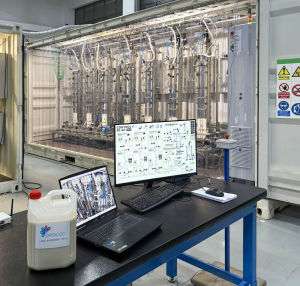
- Installation of the MWAL unit at the MONOLITHOS facilities, ©Monolithos
During the past months, testing of the MWAL unit moved from blank testing to real feedstock, having already processed around 60 kg of spent automotive catalyst samples. The MWAL works with samples that have already been pre-treated: crushed and milled to the required particle size and sorted by metal content. The MWAL trials produced PGM-rich leachates and generated the first preliminary mass balance results at pilot scale, which are still being refined within the project.
The filtration unit performs controlled solid-liquid separation after the MWAL step. Similar to the MWAL unit, it has been equipped by 6TMIC with a SCADA control system and was integrated early in the PEACOC pilot design to allow continuous workflow.
The gas-diffusion electrocrystallisation (GDEx unit), co-developed by VITO together with 6TMIC, consists of a single stack of six electrochemical cells supplied through three fluid streams: catholyte, anolyte and a gas that triggers metallic ion precipitation. A mixing tank allows the catholyte to recirculate, improving process performance. Safety sensors monitor operating conditions across the system. As the previous units, the operation of the GDEx process is controlled by a SCADA system, implemented by 6TMIC, to monitor the most critical operational parameters of the process and automatise its operation stages, from cleaning and emptying to its operation processing the filtrate produced by the previous unit.
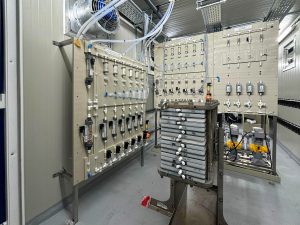
PEACOC GDEx unit stack of six electrochemical cells © PNO Innovation Belgium & PEACOC project
Pilot status by early April 2026
Although the pre-commercial pilot was fully assembled at MONOLITHOS facilities (Athens) in December 2025, the next three months allowed partners to complete commissioning: they have connected all tanks, purchased and calibrated all analytical systems and ensured all units are running according to the required safety infrastructure.
Commissioning tests verified the mechanical and electrical integrity of all modules and confirmed stable operation with both water and real process streams. This extensive testing period allowed partners to identify potential issues related to temperature control, corrosion, leakages, filtration performance and electrochemical operation. These have already been addressed, with no critical problems remaining before continuous operation. In parallel with the ongoing tests, the coming months will be dedicated to the training of the Monolithos technicians, who need to learn to operate, control and monitor the entire pilot system.
All three units are now operational, expected to serve as a demonstrator of a semi-continuous process line for the treatment, filtration and electro-precipitation of CRMs and strategic metals-containing streams, including end-of-life catalysts, printed circuit boards and photovoltaic scrap.
 This
project has received funding from the European Union’s
Horizon 2020 research and innovation programme under grant
agreement No 958302.
This
project has received funding from the European Union’s
Horizon 2020 research and innovation programme under grant
agreement No 958302.